
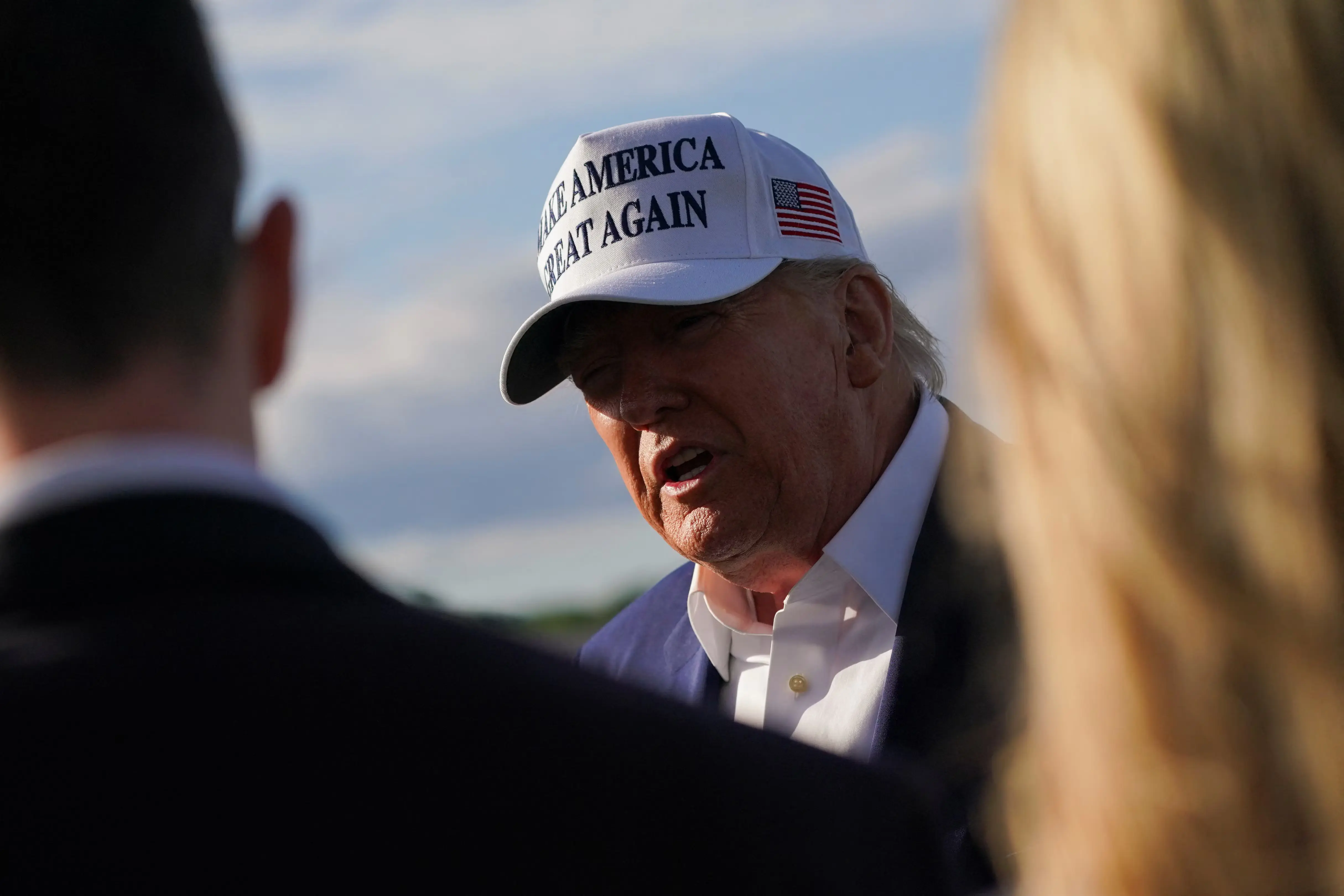
Former President Donald Trump has reignited debate over America's industrial direction by declaring that the United States should prioritize advanced military technology and artificial intelligence over traditional manufacturing, such as textiles.
Speaking at a campaign-style rally in Michigan—a critical swing state and historic manufacturing hub—Trump said, “We want to do the AI thing. We want to make tanks. We don’t want to make T-shirts. You know, making T-shirts is not exciting to me.”
Pushing AI and Defense Over Traditional Industry
Trump’s remarks were part of a broader speech focusing on national security, economic independence, and technological leadership. The former president emphasized the need for the U.S. to dominate in areas like artificial intelligence (AI), robotics, and military production, suggesting that these sectors represent the future of American industry and global influence.
“America has to lead in the technologies of tomorrow,” he said to cheers from a crowd of several thousand. “China is racing ahead in AI and quantum computing. We need to be building our own weapons, our own systems, and training our people for the jobs that matter.”
His comments drew sharp responses from both supporters and critics, with some praising his focus on national security and advanced tech, while others accused him of undermining traditional American manufacturing jobs that support millions of workers.
From Rust Belt to Silicon Battlefield
The event was held near Detroit, a city that has long symbolized the rise and fall of American industrial power. Trump used the setting to draw a contrast between what he described as “old economy” jobs and the “new battlefield” of economic and military power—AI and autonomous defense systems.
“We used to make everything here. Cars, machines—everything. But now, we need to make the machines that think. The machines that fight. That’s how we protect America.”
Critics, however, argue that this rhetoric oversimplifies the economic landscape. “The idea that manufacturing basics like textiles don’t matter anymore is out of touch,” said Lydia Ramos, an economist at the Center for American Industry. “Advanced technology is vital, but so is sustaining a balanced industrial base. T-shirts may not be high-tech, but they represent supply chains, small business livelihoods, and trade leverage.”
AI Strategy Largely Undefined
While Trump made sweeping statements about the need for the U.S. to “do the AI thing,” he did not provide specific policy proposals. His campaign has yet to release a detailed plan outlining how an administration under his leadership would fund, regulate, or guide the development of AI technologies.
Analysts note that while the Trump administration did introduce some AI initiatives during his first term—mainly focused on deregulation and federal coordination—his comments now suggest a stronger emphasis on AI for defense rather than civilian or commercial applications.
“We’re not going to let China build the future while we’re making socks,” Trump concluded. “The future belongs to the strong—and the smart.”
Political Calculations Ahead of 2024 Rematch?
The statement may also signal an attempt to reshape his economic narrative ahead of a potential 2024 general election rematch with President Joe Biden. Trump’s campaign appears to be pivoting toward a techno-nationalist message, combining economic populism with military strength and technological supremacy.
Polls show growing concern among American voters over AI’s impact on jobs and national security. While Biden’s administration has leaned toward regulating AI and ensuring ethical deployment, Trump’s comments suggest a more aggressive, unrestrained approach focused on global competition.
As AI becomes an increasingly central topic in global and domestic policy discussions, Trump’s “tanks not T-shirts” declaration may mark a turning point in how political leaders frame the conversation around technology, labor, and national strength.