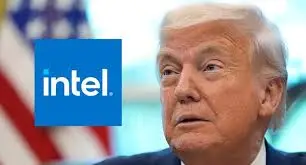
Former U.S. President Donald Trump announced that Intel has agreed to a groundbreaking deal in which the U.S. government will acquire a 10% equity stake in the semiconductor giant. The move is being described as one of the most significant steps in America’s effort to secure leadership in advanced chip manufacturing.
Securing U.S. Semiconductor Future
The deal comes at a time when Washington is aggressively working to reduce dependency on foreign-made chips, particularly from Taiwan and South Korea, which dominate the global semiconductor supply chain. With rising concerns about geopolitical instability in the Taiwan Strait and China’s rapid advancements in technology, this agreement positions Intel as the cornerstone of America’s chip independence strategy.
Trump’s Vision of State Capitalism
By taking direct equity ownership, the U.S. government is venturing into a model of “state capitalism,” a strategy often associated with China. Trump defended the approach, stating it was necessary to safeguard national security and maintain technological superiority in an era of global competition. “We are not just investing in a company; we are investing in America’s future,” Trump declared.
Intel’s Strategic Role
Intel, once considered to be losing ground to Asian rivals like TSMC and Samsung, has been revitalizing its operations through the CHIPS and Science Act funding. The government’s 10% stake is expected to bring additional stability and foster long-term collaboration between policymakers and the private sector. Industry experts say this may also unlock new subsidies, accelerate factory construction in Arizona, Ohio, and Oregon, and bolster domestic R&D.
Political and Economic Reactions
The move has sparked debate across political and business circles. Supporters hail it as a bold initiative to reclaim U.S. leadership in chipmaking, while critics warn it blurs the line between government and private enterprise. Economists suggest the precedent could lead to further state stakes in other critical technology sectors.
Global Implications
This deal is expected to reverberate across the international semiconductor market. U.S. allies may adopt similar strategies, while rivals like China could see this as further evidence of Washington weaponizing industrial policy. The development intensifies the already fierce U.S.-China tech rivalry, with semiconductors at the heart of the struggle.