
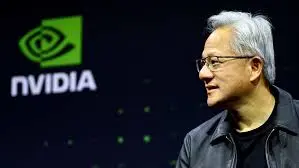
Nvidia CEO Jensen Huang announced that the company is witnessing strong global demand for its Blackwell AI chips, which were unveiled earlier this year as the successor to the highly successful Hopper architecture. The Blackwell line, designed to handle massive AI workloads, has attracted orders from major cloud service providers and AI developers worldwide.
Powering the Next Wave of AI Innovation
Huang emphasized that the Blackwell chips are central to powering advanced generative AI and machine learning models, enabling faster training speeds and improved energy efficiency. Companies ranging from cloud computing giants to research institutions are turning to Nvidia’s new GPUs to accelerate AI deployment and maintain a competitive edge in the rapidly evolving tech landscape.
Major Clients Lining Up for Supply
According to industry sources, Amazon Web Services, Microsoft Azure, and Google Cloud are among the early adopters of Blackwell-based systems. Demand is reportedly outpacing supply, with Nvidia working closely with Taiwan Semiconductor Manufacturing Company (TSMC) to scale up production. Huang noted that “every major data center operator wants Blackwell,” underscoring the chip’s critical role in global AI infrastructure.
Outpacing Competitors in the AI Hardware Race
The surge in demand highlights Nvidia’s continued leadership in the AI hardware sector, outpacing rivals like AMD’s MI300 and Intel’s Gaudi accelerators. Analysts predict that the Blackwell generation could further strengthen Nvidia’s market share, which already exceeds 80% in the high-performance AI chip segment.
Economic and Strategic Implications
The Blackwell boom also has wider economic implications, as nations compete to secure AI compute resources. Nvidia’s technology underpins the training of models used in everything from autonomous vehicles to scientific simulations, making it a vital component in the AI-driven global economy.
Looking Ahead: Supply Chain and Expansion
To meet skyrocketing demand, Nvidia is expanding partnerships with chip manufacturers and cloud infrastructure firms, while also working on next-generation designs. Huang expressed optimism about the future, saying that the AI revolution is still in its early stages, and Nvidia intends to “build the computing fabric of the new industrial age.”