
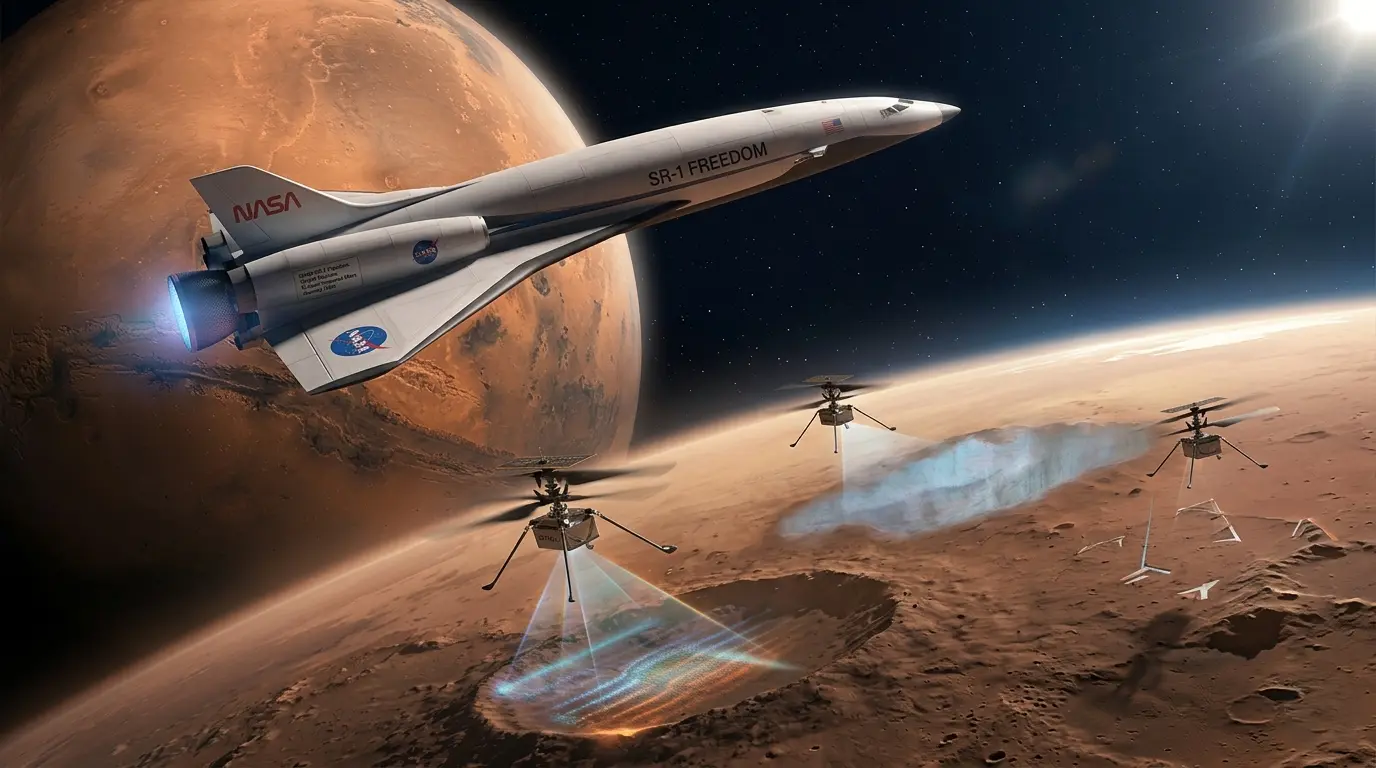
NASA is reportedly advancing plans for an ambitious Mars mission, codenamed “Skyfall,” that could rely on nuclear-powered spacecraft to significantly cut travel time and enhance mission efficiency. The concept marks a major shift from traditional chemical propulsion, signaling a new era in deep-space exploration where speed and sustainability are critical.
Why Nuclear Power Matters in Space Travel
Unlike conventional rockets, nuclear-powered systems—particularly nuclear thermal propulsion (NTP) or nuclear electric propulsion (NEP)—offer far greater efficiency. These systems can generate sustained thrust over longer durations, potentially reducing the journey to Mars from around seven months to as little as three to four months. Faster transit not only lowers mission costs but also reduces astronauts’ exposure to cosmic radiation.
The “Skyfall” Mission Vision
The Skyfall mission is being conceptualized as a high-speed, crew-capable journey to Mars, possibly involving advanced landing technologies and precision descent systems. The mission’s name hints at a controlled, high-speed atmospheric entry—an approach that could allow spacecraft to deliver heavier payloads more efficiently onto the Martian surface.
Partnerships and Technology Development
NASA is collaborating with private aerospace firms and defense contractors to accelerate the development of nuclear propulsion systems. Recent investments and testing initiatives, including ground-based reactor experiments, suggest that the agency is serious about deploying this technology within the next decade. The U.S. government has also shown strong interest in nuclear propulsion as part of its broader space strategy.
Challenges and Safety Concerns
Despite its promise, nuclear propulsion comes with technical and political hurdles. Engineers must ensure reactor safety during launch and operation, while policymakers must address concerns about radioactive materials in space missions. Strict regulations and international agreements will likely shape how and when such missions are deployed.
Implications for Future Space Exploration
If successful, the Skyfall mission could revolutionize not just Mars exploration but also missions to deeper destinations such as Jupiter’s moons or Saturn. Nuclear propulsion could enable more frequent and flexible missions, opening new opportunities for scientific discovery and human expansion beyond Earth.