
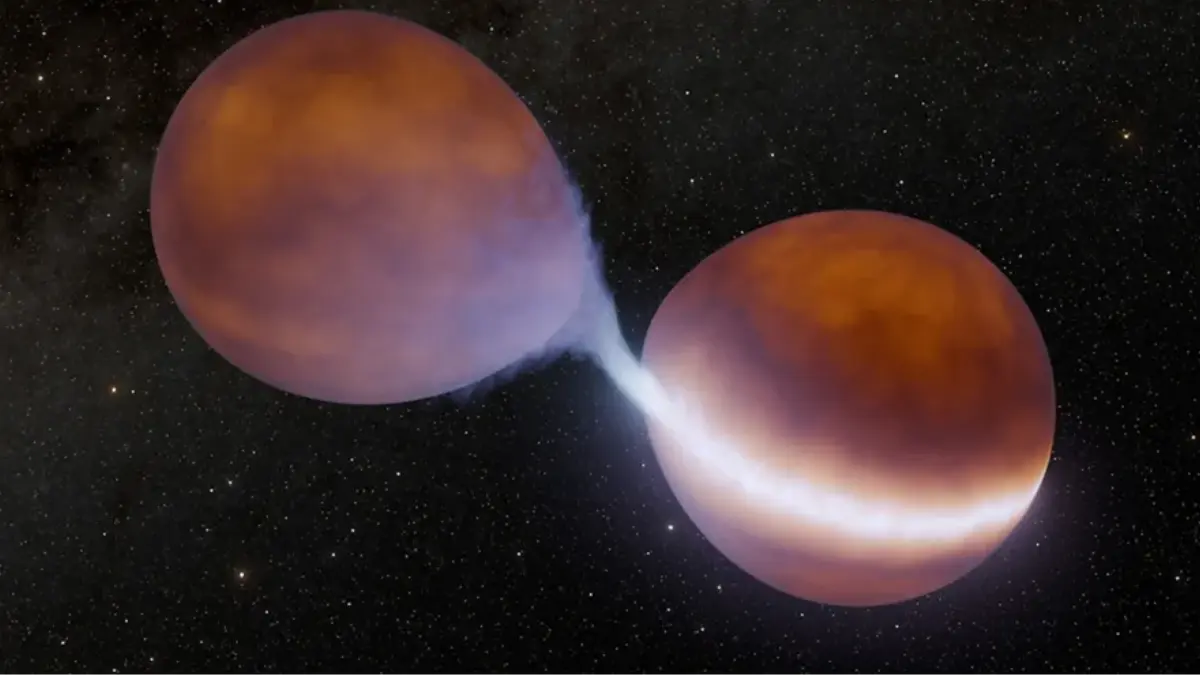
Astronomers have identified a fascinating celestial event where two brown dwarfs—often referred to as “failed stars”—are on a collision course that could ultimately trigger the birth of a new star. This rare observation challenges long-held assumptions about stellar formation, offering a glimpse into how even substellar objects might reignite nuclear fusion under the right conditions.
What Are Brown Dwarfs?
Brown dwarfs occupy a unique space between planets and stars. They are too massive to be considered planets, yet lack the necessary mass to sustain hydrogen fusion in their cores—the defining process of a true star. Because of this, they typically cool and fade over time. However, scientists now believe that merging brown dwarfs may accumulate enough mass to cross the threshold required for stellar ignition.
The Power of a Merger
The newly observed system suggests that when two brown dwarfs spiral toward each other and eventually merge, the combined mass could surpass the critical limit—roughly 75 to 80 times the mass of Jupiter—needed to kickstart nuclear fusion. If this threshold is reached, the merged object could transition into a low-mass star, emitting sustained light and heat for millions or even billions of years.
How Scientists Made the Discovery
Using advanced telescopes and infrared observations, astronomers tracked unusual motion and energy patterns in a distant binary system composed of two brown dwarfs. The data revealed gravitational interactions and orbital decay consistent with an eventual merger. Spectroscopic analysis also hinted at increasing temperatures and dynamic changes in the surrounding environment.
Rethinking Stellar Evolution
This finding opens up a new pathway in our understanding of how stars can form. Traditionally, stars are believed to originate from collapsing clouds of gas and dust. The possibility that stellar birth can also occur through mergers of substellar objects adds complexity to existing models and could explain certain low-mass stars observed across the galaxy.
Implications for Future Research
The discovery provides astronomers with a valuable opportunity to study the early stages of stellar ignition in real time. Future observations using next-generation telescopes, including space-based infrared observatories, are expected to monitor the system closely. Scientists hope to confirm whether the merger will indeed lead to sustained fusion, marking the transformation into a true star.